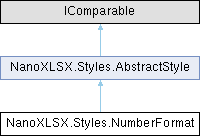
Class representing a NumberFormat entry. The NumberFormat entry is used to define cell formats like currency or date. More...
Public Types | |
| enum | FormatNumber { None = 0 , Format1 = 1 , Format2 = 2 , Format3 = 3 , Format4 = 4 , Format5 = 5 , Format6 = 6 , Format7 = 7 , Format8 = 8 , Format9 = 9 , Format10 = 10 , Format11 = 11 , Format12 = 12 , Format13 = 13 , Format14 = 14 , Format15 = 15 , Format16 = 16 , Format17 = 17 , Format18 = 18 , Format19 = 19 , Format20 = 20 , Format21 = 21 , Format22 = 22 , Format37 = 37 , Format38 = 38 , Format39 = 39 , Format40 = 40 , Format45 = 45 , Format46 = 46 , Format47 = 47 , Format48 = 48 , Format49 = 49 , Custom = 164 } |
| Enum for predefined number formats, used by implementations of the NumberFormat class. More... | |
| enum | FormatRange { DefinedFormat , CustomFormat , Invalid , Undefined } |
| Range or validity of the format number, used by the NumberFormat class. More... | |
Public Member Functions | |
| NumberFormat () | |
| Default constructor. | |
| override string | ToString () |
| Override toString method. | |
| override AbstractStyle | Copy () |
| Method to copy the current object to a new one without casting. | |
| NumberFormat | CopyNumberFormat () |
| Method to copy the current object to a new one with casting. | |
| override int | GetHashCode () |
| Returns a hash code for this instance. | |
| override bool | Equals (object obj) |
| Returns whether two instances are the same. | |
| Public Member Functions inherited from NanoXLSX.Styles.AbstractStyle | |
| AbstractStyle | Copy () |
| Abstract method to copy a component (dereferencing). | |
| int | CompareTo (AbstractStyle other) |
| Method to compare two objects for sorting purpose. | |
| bool | Equals (AbstractStyle other) |
| Method to compare two objects for sorting purpose. | |
Static Public Member Functions | |
| static bool | IsDateFormat (FormatNumber number) |
| Determines whether a defined style format number represents a date (or date and time). | |
| static bool | IsTimeFormat (FormatNumber number) |
| Determines whether a defined style format number represents a time). | |
| static FormatRange | TryParseFormatNumber (int number, out FormatNumber formatNumber) |
| Tries to parse registered format numbers. If the parsing fails, it is assumed that the number is a custom format number (164 or higher) and 'custom' is returned. | |
Static Public Attributes | |
| static readonly int | CustomFormatStartNumber = 164 |
| Start ID for custom number formats as constant (value 164). | |
| static readonly FormatNumber | DefaultNumber = FormatNumber.None |
| Default format number as constant. | |
Properties | |
| string | CustomFormatCode [get, set] |
| Gets or sets the raw custom format code in the notation of Excel. The code is not escaped or unescaped (on workbook loading). | |
| int | CustomFormatID [get, set] |
| Gets or sets the format number of the custom format. Must be higher or equal then predefined custom number (164). | |
| bool | IsCustomFormat [get] |
| Gets whether the number format is a custom format (higher or equals 164). If true, the format is custom. | |
| FormatNumber | Number [get, set] |
| Gets or sets the format number. Set this to custom (164) in case of custom number formats. | |
| Properties inherited from NanoXLSX.Styles.AbstractStyle | |
| int? | InternalID [get, set] |
| Gets or sets the internal ID for sorting purpose in the Excel style document (nullable). | |
Detailed Description
Class representing a NumberFormat entry. The NumberFormat entry is used to define cell formats like currency or date.
Definition at line 17 of file NumberFormat.cs.
Member Enumeration Documentation
◆ FormatNumber
Enum for predefined number formats, used by implementations of the NumberFormat class.
- Remarks
- There are other predefined formats (e.g. 43 and 44) that are not listed. The declaration of such formats is done in the number formats section of the style document, whereas the officially listed ones are implicitly used and not declared in the style document
| Enumerator | |
|---|---|
| None | No format / Default. |
| Format1 | Format: 0. |
| Format2 | Format: 0.00. |
| Format3 | Format: #,##0. |
| Format4 | Format: #,##0.00. |
| Format5 | Format: $#,##0_);($#,##0). |
| Format6 | Format: $#,##0_);Red. |
| Format7 | Format: $#,##0.00_);($#,##0.00). |
| Format8 | Format: $#,##0.00_);Red. |
| Format9 | Format: 0%. |
| Format10 | Format: 0.00%. |
| Format11 | Format: 0.00E+00. |
| Format12 | Format: # ?/? . |
| Format13 | Format: # ??/?? . |
| Format14 | Format: m/d/yyyy. |
| Format15 | Format: d-mmm-yy. |
| Format16 | Format: d-mmm. |
| Format17 | Format: mmm-yy. |
| Format18 | Format: mm AM/PM. |
| Format19 | Format: h:mm:ss AM/PM. |
| Format20 | Format: h:mm. |
| Format21 | Format: h:mm:ss. |
| Format22 | Format: m/d/yyyy h:mm. |
| Format37 | Format: #,##0_);(#,##0). |
| Format38 | Format: #,##0_);Red. |
| Format39 | Format: #,##0.00_);(#,##0.00). |
| Format40 | Format: #,##0.00_);Red. |
| Format45 | Format: mm:ss. |
| Format46 | Format: [h]:mm:ss. |
| Format47 | Format: mm:ss.0. |
| Format48 | Format: ##0.0E+0. |
| Format49 | Format: #. |
| Custom | Custom Format (ID 164 and higher). |
Definition at line 38 of file NumberFormat.cs.
◆ FormatRange
Range or validity of the format number, used by the NumberFormat class.
Definition at line 111 of file NumberFormat.cs.
Constructor & Destructor Documentation
◆ NumberFormat()
| NanoXLSX.Styles.NumberFormat.NumberFormat | ( | ) |
Default constructor.
Definition at line 198 of file NumberFormat.cs.
Member Function Documentation
◆ Copy()
| override AbstractStyle NanoXLSX.Styles.NumberFormat.Copy | ( | ) |
Method to copy the current object to a new one without casting.
- Returns
- Copy of the current object without the internal ID
Definition at line 228 of file NumberFormat.cs.
◆ CopyNumberFormat()
| NumberFormat NanoXLSX.Styles.NumberFormat.CopyNumberFormat | ( | ) |
Method to copy the current object to a new one with casting.
- Returns
- Copy of the current object without the internal ID
Definition at line 243 of file NumberFormat.cs.
◆ Equals()
| override bool NanoXLSX.Styles.NumberFormat.Equals | ( | object | obj | ) |
Returns whether two instances are the same.
- Parameters
-
obj Object to compare
- Returns
- True if this instance and the other are the same
Definition at line 271 of file NumberFormat.cs.
◆ GetHashCode()
| override int NanoXLSX.Styles.NumberFormat.GetHashCode | ( | ) |
Returns a hash code for this instance.
- Returns
- A hash code for this instance, suitable to be used in hashing algorithms and data structures like a hash table.
Definition at line 254 of file NumberFormat.cs.
◆ IsDateFormat()
|
static |
Determines whether a defined style format number represents a date (or date and time).
- Parameters
-
number Format number to check
- Returns
- True if the format represents a date, otherwise false
- Remarks
- Custom number formats (higher than 164), as well as not officially defined numbers (below 164) are currently not considered during the check and will return false
Definition at line 289 of file NumberFormat.cs.
◆ IsTimeFormat()
|
static |
Determines whether a defined style format number represents a time).
- Parameters
-
number Format number to check
- Returns
- True if the format represents a time, otherwise false
- Remarks
- Custom number formats (higher than 164), as well as not officially defined numbers (below 164) are currently not considered during the check and will return false
Definition at line 310 of file NumberFormat.cs.
◆ ToString()
| override string NanoXLSX.Styles.NumberFormat.ToString | ( | ) |
◆ TryParseFormatNumber()
|
static |
Tries to parse registered format numbers. If the parsing fails, it is assumed that the number is a custom format number (164 or higher) and 'custom' is returned.
- Parameters
-
number Raw number to parse formatNumber Out parameter with the parsed format enum value. If parsing failed, 'custom' will be returned
- Returns
- Format range. Will return 'invalid' if out of any range (e.g. negative value)
Definition at line 333 of file NumberFormat.cs.
Member Data Documentation
◆ CustomFormatStartNumber
|
static |
Start ID for custom number formats as constant (value 164).
Definition at line 23 of file NumberFormat.cs.
◆ DefaultNumber
|
static |
Default format number as constant.
Definition at line 27 of file NumberFormat.cs.
Property Documentation
◆ CustomFormatCode
|
getset |
Gets or sets the raw custom format code in the notation of Excel. The code is not escaped or unescaped (on workbook loading).
- Exceptions
-
NanoXLSX.Exceptions.FormatException Throws a FormatException if passed value is null or empty
- Remarks
- Currently, there is no auto-escaping applied to custom format strings. For instance, to add a white space, internally it is escaped by a backspace (\ ). To get a valid custom format code, this escaping must be applied manually, according to OOXML specs: Part 1 - Fundamentals And Markup Language Reference, Chapter 18.8.31
Definition at line 145 of file NumberFormat.cs.
◆ CustomFormatID
|
getset |
Gets or sets the format number of the custom format. Must be higher or equal then predefined custom number (164).
- Exceptions
-
NanoXLSX.Exceptions.StyleException Throws a StyleException if the number is below the lowest possible custom number (164)
Definition at line 162 of file NumberFormat.cs.
◆ IsCustomFormat
|
get |
Gets whether the number format is a custom format (higher or equals 164). If true, the format is custom.
Definition at line 178 of file NumberFormat.cs.
◆ Number
|
getset |
Gets or sets the format number. Set this to custom (164) in case of custom number formats.
Definition at line 191 of file NumberFormat.cs.
The documentation for this class was generated from the following file: